



Observatory analysis followed by an edited release supplied by Cydome Security.
The announcement
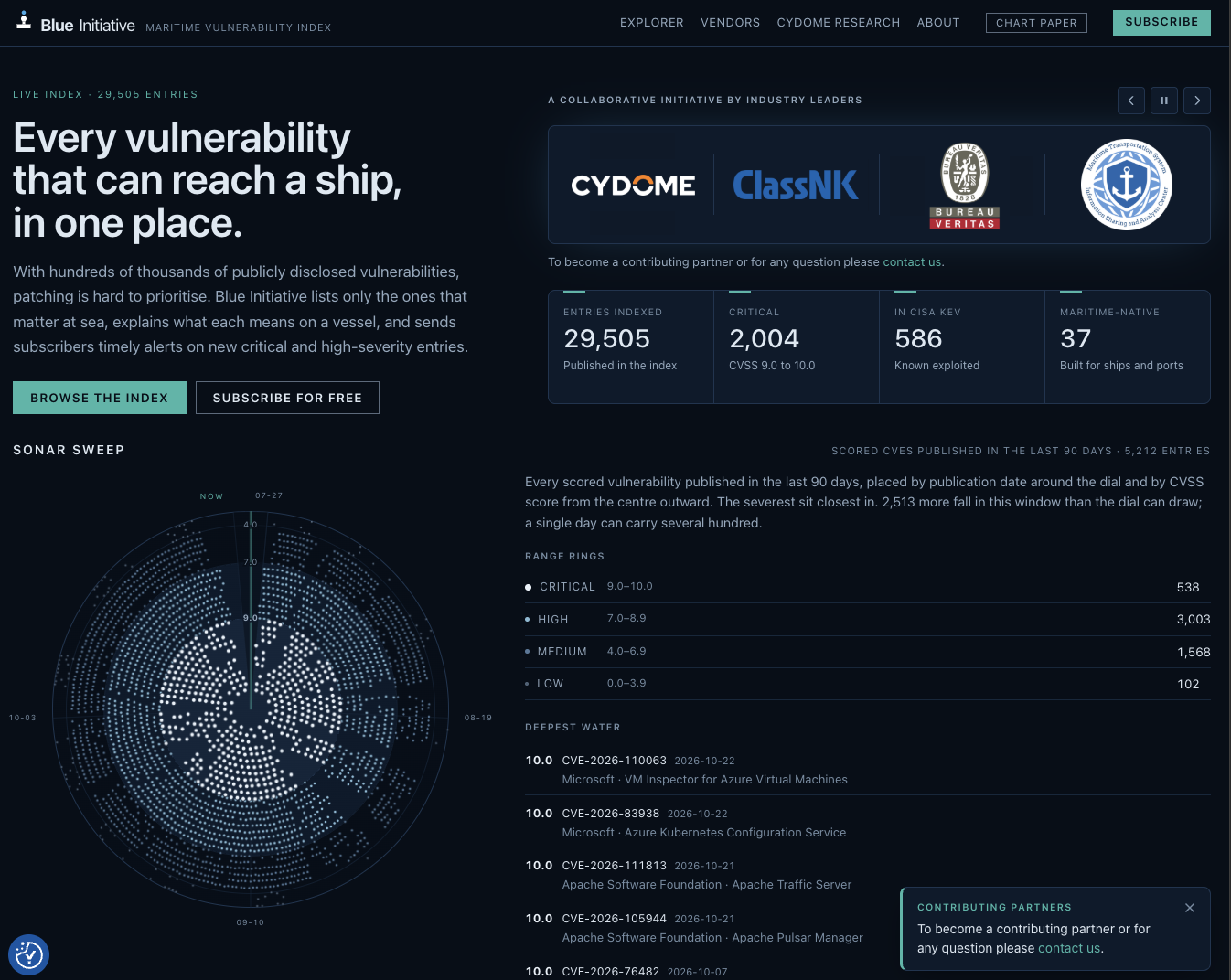
LONDON — Cydome, ClassNK, Bureau Veritas, MTS-ISAC, and Rakuten Maritime announced Blue Initiative on Oct. 26, a public database of cybersecurity vulnerabilities affecting maritime information technology and operational technology.
The free resource, available at blue-initiative.org, allows users to browse vulnerabilities, filter findings by equipment or vendor, access selected analyst assessments, and subscribe to alerts.
The partners describe it as the first public maritime-specific vulnerability database. That claim has not been independently verified.
“Identifying which vulnerabilities actually matter to the systems maritime companies operate is a major challenge,” said Cydome CEO Nir Ayalon.
Ayalon said the initiative aims to provide a focused view of risks relevant to individual vessels, helping technical teams identify and prioritize vulnerabilities.
“Effective vulnerability management starts with knowing which issues matter to the systems you operate,” said Naoki Saito, general manager of ClassNK’s Ship Management Systems Department.
According to Cydome, researchers from the company and participating organizations validate and refine entries before publication. Selected entries also receive more detailed analyst notes.
Panagiotis Anastasiou, cyber technical and market leader at Bureau Veritas Marine & Offshore, emphasized that cybersecurity requires continuing attention throughout a vessel’s working life.
“Owners are expected to maintain the security of onboard systems as new vulnerabilities emerge, making effective vulnerability management a critical element of maritime cyber resilience,” Anastasiou said.
He said relevant information is often scattered across general databases and equipment-vendor advisories.
MTS-ISAC, a nonprofit maritime cybersecurity information-sharing organization, says it has incorporated the initiative into its operations.
The organization “has integrated its operational workflows to both contribute to and leverage this vital initiative,” said Christy Coffey, its vice president of operations.
“Cybersecurity must be managed across a vessel’s entire operational lifecycle, from design through operation,” said Ryan Son, managing director of Rakuten Symphony Singapore & Korea and head of Rakuten Maritime.
Cydome, which operates and funds the database, also sells maritime cybersecurity products and managed services. Other maritime organizations are invited to contribute to the project.
Source: Cydome Security release distributed through EIN Presswire, Oct. 26, 2026. Edited for length and clarity. The Observatory assessment is separate editorial analysis.
The Observatory assessment
Blue Initiative addresses an information bottleneck: determining which published cybersecurity vulnerabilities affect the equipment maritime operators actually use.
The Observatory tracks both Data Availability and Quality and Cybersecurity Response Capacity as constraints on essential systems. A maritime-specific database could reduce the work of identifying relevant threats. Operators must still match those findings to installed equipment, prioritize action, and complete remediation.
The distinction follows our earlier maritime analysis: maintaining activity and building resilience are different achievements. A new information resource becomes evidence of greater resilience when its use produces measurable operational improvements.
There is an early adoption signal. MTS-ISAC says it has integrated the initiative into its workflows. The release provides no figures for fleet adoption, remediation times, or reduced downtime.
One assurance question remains unresolved. According to Cydome, researchers validate entries before publication, while the project’s published methodology describes automated publication, with analyst notes on selected entries. The scope and timing of human review need clarification.
Assessment: A potentially useful contribution to maritime cybersecurity, with claimed operational use. Its effect on fleet reliability remains unmeasured.


